


kategória
szerző
cím
sorozat
betöltés...
kiadó
betöltés...
ISBN
évszám
ár
-
leírás
Előrendelhető
A mezők bármelyike illeszkedjen
A mezők mind illeszkedjen


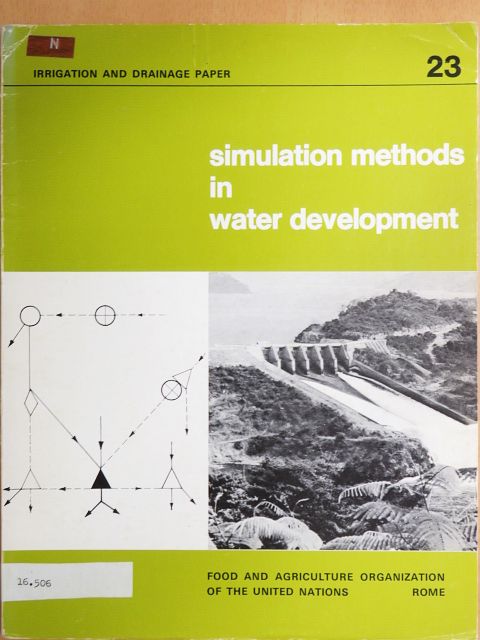
Simulation methods in water development [antikvár]
D. P. Carr, H. W. Underhill

SIMULATICW METHODS IN WATER DEVELOPMENT
INTROHJCTIOi
This paper is intended to be a practical introduction to the use of simulation as an aid in the planning of water resources development, with particular reference to irrigation» It has been prepared primarily for the busy field hydrologist or engineer who has neither the facilities nor the time to keep up to date with rapidly changing technologyi it is hoped that it will also be useful to project managers and planners who, though not themselves hydrologists or engineers, are concerned...
online ár:
Webáruházunkban a termékek mellett feltüntetett fekete színű online ár csak internetes megrendelés esetén érvényes.
4780 Ft

Részletesen erről a termékről
Bővebb ismertető
SIMULATICW METHODS IN WATER DEVELOPMENT
INTROHJCTIOi
This paper is intended to be a practical introduction to the use of simulation as an aid in the planning of water resources development, with particular reference to irrigation» It has been prepared primarily for the busy field hydrologist or engineer who has neither the facilities nor the time to keep up to date with rapidly changing technologyi it is hoped that it will also be useful to project managers and planners who, though not themselves hydrologists or engineers, are concerned with water development studies and who make use of the results of hydrological analyses* The background to and description of simulation methods and problems are given in Part I, and illustrative case studies are presented in Part II.
But first the What, Why and How? What is meant by simulation of systems? Why and when is it useful and what are its advantages and disadvantages compared with traditional methods? How is it to be done, what are the steps, pitfalls and uses? These questions will be considered briefly in turn.
In this paper a water resource "system" is taken to mean an intervention by man between water resources and water needs. A canal for the diversion of water from a river for a single purpose, for example to supply irrigation water, represents one of the simplest possible types of system. At more complex levels a system may consist of a combination of reservoirs^ canals and groundwater schemes designed to satisfy several objectives which may be comply mentary or competing. The conjunctive use of surface water and groundwater represents a convenient and flexible type of system when the available resources permit this form of dev^ lopment. The scope of the present paper, however, is limited to a discussion of the simpler type of surface water storage systems, althoiigh the simulation methodology outlined in these pages may be readily used when investigating more complex multiple resource systems. Likewise for simplicity this paper is limited to consideration of the quantitative aspects of problems of water supply, though simulation can also be applied to water quality.
Simulation, in the sense used here, is the numerical representation of sequences of events that could occur in real life. To be more correct we should speak of numerical sequential simulation; numerical because there are other forms of simulation - for example by electrical or hydraulic analogue - and sequential because a model which excluded the time dimension would be of no interest to us since the key factor in hydrology is variability in time. Therefore we simulate the operation of our system in time by using, as our input, sequences of observed, or generated but realistic, hydrological data.
The simulation of systems is one of the tools used in the wider field called systems analysis. "The purpose of systems analysis is to enable the analyst to modify the system characteristics in such a way as to optimise the value function for the system outputs** (Beard, 1973, p* 5^0)» Systems simulation presents a rational approach to the problem of choosing between a range of possible alternative designs. Provided we have sufficient num^ rical information on the elements and relationships that go to make up the system we can test many alternative system configurations and so find the one which most nearly approaches our goal, or which gives us the highest return according to whatever criteria we use to assess the value of the proposed development.
The advantages of simulation over traditional methods of establishing the design values for water development schemes are discussed later, but in brief the traditional methods in use before the computer era could not handle the complexity of multiple storage systems nor the large amount of calculation required for probabilistic analysis, which is to say the assessment of the risk of the system failing to meet our needs. The advent of the computer has therefore allowed the development of both a new philosophy and new techniques in the field of water resources.
Termékadatok
Cím: Simulation methods in water development [antikvár]
Kötés: Varrott papírkötés
Méret: 220 mm x 280 mm
Új vásárló vagyok!
új vásárlóval indíthatsz rendelést............