


kategória
szerző
cím
sorozat
betöltés...
kiadó
betöltés...
ISBN
évszám
ár
-
leírás
Előrendelhető
A mezők bármelyike illeszkedjen
A mezők mind illeszkedjen


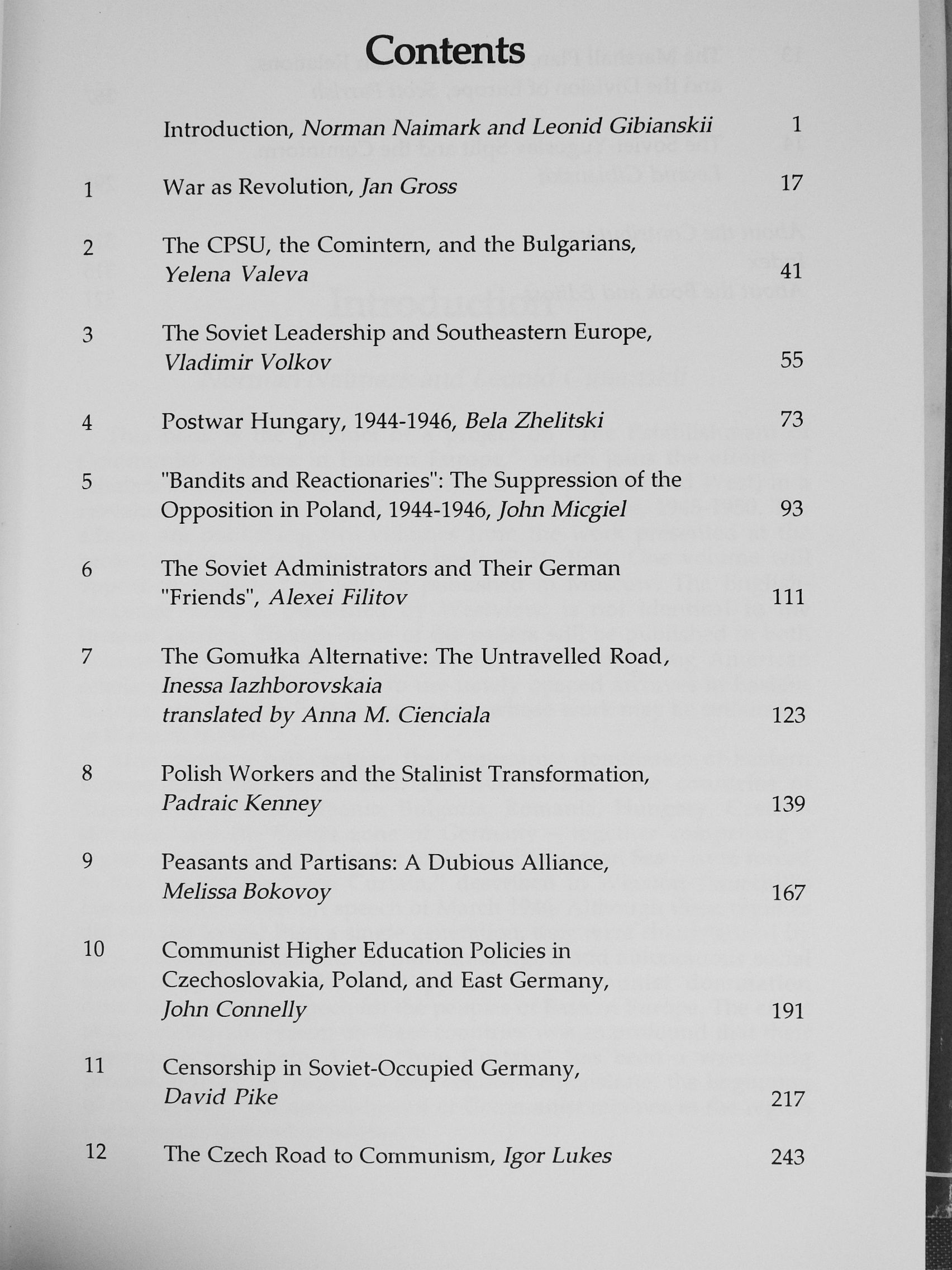
The Establishment of Communist Regimes in Eastern Europe, 1944-1949 [antikvár]
John Micgiel, Padraic Kenney, Yelena Valeva

Introduction
Norman Naimark and Leonid Gibianskii
This book is the product of a project on "The Establishment of Communist Regimes in Eastern Europe," which joins the efforts of scholars in Russia, the United States, and Europe (East and West) in a réévaluation of the history of postwar Eastern Europe, 1945-1950. The editors are publishing two volumes from the work presented at the project's Moscow conference of March 29-31, 1994. One volume will appear in Russian and will be published in Moscow. The English-language volume, published by...
online ár:
Webáruházunkban a termékek mellett feltüntetett fekete színű online ár csak internetes megrendelés esetén érvényes.
22000 Ft

Részletesen erről a termékről
Bővebb ismertető
Introduction
Norman Naimark and Leonid Gibianskii
This book is the product of a project on "The Establishment of Communist Regimes in Eastern Europe," which joins the efforts of scholars in Russia, the United States, and Europe (East and West) in a réévaluation of the history of postwar Eastern Europe, 1945-1950. The editors are publishing two volumes from the work presented at the project's Moscow conference of March 29-31, 1994. One volume will appear in Russian and will be published in Moscow. The English-language volume, published by Westview, is not identical to the Russian version. Though some of the papers will be published in both volumes, this book highlights the contributions of young American scholars, who have been able to use newly opened archives in Eastern Europe, and Russian East Europeanists, whose work may be unfamiliar to Western readers.
After nearly a half century, the Communist domination of Eastern Europe has come to an end. For five decades, the countries of Yugoslavia, Poland, Albania, Bulgaria, Romania, Hungary, Czechoslovakia, and the Soviet zone of Germany - together comprising a region stretching from the Baltic to the Mediterranean Sea - were forced to live behind the "Iron Curtain," described in Winston Churchill's famous Fulton, Missouri speech of March 1946. Although these regimes did not last longer than a single generation, they were characterized by such fundamental assaults on individual rights and autonomous social institutions that, in fact, the period of Communist domination constituted an entire epoch for the peoples of Eastern Europe. The effect of the totalitarian system on these countries was so profound that their emergence from behind the "Iron Curtain" has been a wrenching process. But, as the papers in this volume demonstrate, the beginning of this history - the establishment of Communist regimes in the region - was no less difficult or traumatic.
Termékadatok
Cím: The Establishment of Communist Regimes in Eastern Europe, 1944-1949 [antikvár]
Kiadó: Westview Press
Kötés: Vászon
ISBN: 0813389976
Méret: 160 mm x 230 mm
Új vásárló vagyok!
új vásárlóval indíthatsz rendelést............