


kategória
szerző
cím
sorozat
betöltés...
kiadó
betöltés...
ISBN
évszám
ár
-
leírás
Előrendelhető
A mezők bármelyike illeszkedjen
A mezők mind illeszkedjen


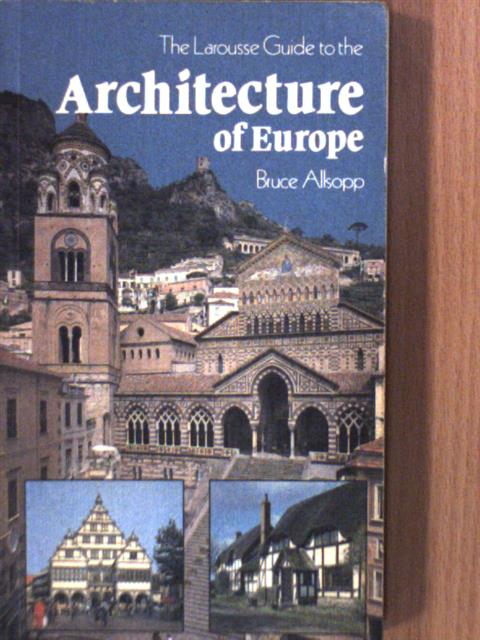
The Larousse Guide to the Architecture of Europe [antikvár]
Bruce Allsopp

How to use this bookThis is a guide to architecture as it is now, astourists and students see it. Some is very oldand has changed through time. Some isyoung and almost as it was when the buildingwas finished. This is not a history book, butwe have to be aware of how time and changeconstantly affect architecture. Architecture isborn by building. The building has a life-spanand a death by decay or demolition. It isnecessary to recognise buildings as livingcreations rather than static objects.Part One is about the nature of architecture,what it...
online ár:
Webáruházunkban a termékek mellett feltüntetett fekete színű online ár csak internetes megrendelés esetén érvényes.
3940 Ft

Részletesen erről a termékről
Bővebb ismertető
How to use this bookThis is a guide to architecture as it is now, astourists and students see it. Some is very oldand has changed through time. Some isyoung and almost as it was when the buildingwas finished. This is not a history book, butwe have to be aware of how time and changeconstantly affect architecture. Architecture isborn by building. The building has a life-spanand a death by decay or demolition. It isnecessary to recognise buildings as livingcreations rather than static objects.Part One is about the nature of architecture,what it is, the different kinds of architecture,how it was built, how it was designed and forwhat purpose. You need to read Part One.Part Two is about the styles and periods ofarchitecture in Europe, how and why theycame into being through the people who builtthem. There is much that is common to all thecountries of Europe so this part is constantlyreferred to in Part Three which consists of aregional breakdown.Parts Three and Four are specific to countriesor regions, indicating regional characteristicsand the reasons for them; Part Three coveringroughly that area included in the RomanEmpire, and Four the regions beyond it.To cover the whole range of Europeanarchitecture in a single handbook it has beenessential to avoid repetition and to be concisebut without being merely factual. The text ismeant to be read, mainly as explanation ofhow and why. The illustrations convey visuallymany of the facts of architecture and thecaptions do not duplicate the text. Text,pictures and captions on each pair of pagesare a package, like one house in a street. Thecross references are important to avoidrepetition and by using them you mayincrease your capacity to appreciatearchitecture and probably your desire toextend your travels.This book is about architecture and thepeople who built. It aims to help you to enjoyarchitecture quite apart from all theassociations with people who have acted outtheir lives on the stage the buildings provided.You can learn of these as well as some detailsabout the buildings from the local guides, butwe think that nowhere else in such conciseform can you learn to see individual buildings,from cathedrals to cottages, in the context ofEuropean architecture.The quantity of building done in the presentcentury may exceed everything built before it.We have chosen to use time as a scale, notquantity, so the Modernist period gets lessspace than the Middle Ages or even theRenaissance.From the beginning, architecture has had abasic standard. The great sculptor AugusteRodin called it Taste. He wrote, Taste is theadaptation of human will and human forces tothe will and forces of nature.'About the middle of the present centuryman began to believe that the will and forcesof nature could and should be subject toman's technology. Where this will lead we donot know. Architecture has changed: man isfearful but the heritage remains - thoughprecariously.Finally, in this book the word architecture is'meaningful' or 'significant' building andarchitect means any person or people whohave designed buildings which arearchitecture.
Termékadatok
Cím: The Larousse Guide to the Architecture of Europe [antikvár]
Szerző:
Bruce Allsopp
Kiadó: Larousse and Co. Inc.
Kötés: Fűzött papírkötés
ISBN: 0883324571
Méret: 120 mm x 190 mm
Új vásárló vagyok!
új vásárlóval indíthatsz rendelést............