


kategória
szerző
cím
sorozat
betöltés...
kiadó
betöltés...
ISBN
évszám
ár
-
leírás
Előrendelhető
A mezők bármelyike illeszkedjen
A mezők mind illeszkedjen


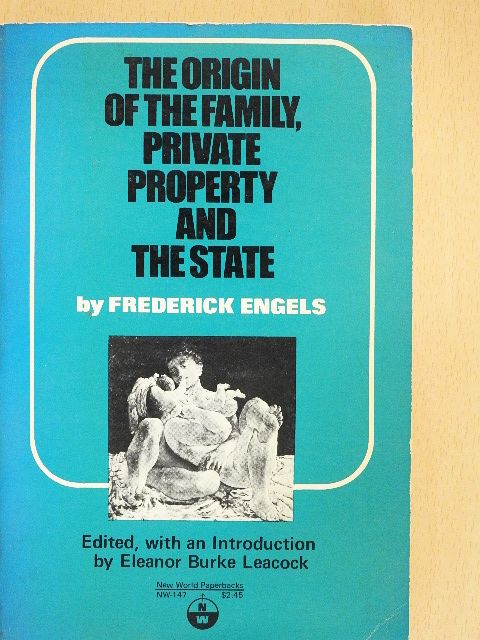
The Origin of the Family, Private Property and the State [antikvár]
Frederick Engels

INTRODUCTION by Eleanor Burke Leacock
In the Origin oj the Family, Private Property and the State, Engels outlines the successive social and economic forms which underlay the broad sweep of early human history, as mankind gained increasing mastery over the sources of subsistence. The book was written after Marx's death, but was drawn from Marx's as well as Engels' own notes. It was based on the work, Ancient Society, which appeared in 1877 and was written by the anthropologist Lewis Henry Morgan, who, as Engels wrote in 1884, "in his own...
online ár:
Webáruházunkban a termékek mellett feltüntetett fekete színű online ár csak internetes megrendelés esetén érvényes.
3780 Ft

Részletesen erről a termékről
Bővebb ismertető
INTRODUCTION by Eleanor Burke Leacock
In the Origin oj the Family, Private Property and the State, Engels outlines the successive social and economic forms which underlay the broad sweep of early human history, as mankind gained increasing mastery over the sources of subsistence. The book was written after Marx's death, but was drawn from Marx's as well as Engels' own notes. It was based on the work, Ancient Society, which appeared in 1877 and was written by the anthropologist Lewis Henry Morgan, who, as Engels wrote in 1884, "in his own way . discovered afresh in America the materialistic conception of history discovered by Marx 40 years ago." The contribution Marx and Engels made to Morgan's work was to sharpen its theoretical implications, particularly with regard to the emergence of classes and the state. Although Engels' book was written well before most of the now available material on primitive and early urban society had been amassed, the fundamentals of his outline for history have remained valid. Moreover, many issues raised by Morgan's and then Engels' work are still the subjects of lively debate among anthropologists, while the theoretical implications of these issues are still matters of concern to Marxist scholars generally.
Morgan described the evolution of society in some 560 pages. Engels' book is far shorter, summarizing Morgan's material and focusing sharply on the major differences between primitive society and "civilization" with its fully developed classes and political organization. The questions Engels deals with pertain to three major topics: (a) developmental stages in mankind's history, (b) the nature of primitive society with regard to property, rank, family forms and descent systems, and (c) the emergence of commodity production, economically based classes and the state. A fourth subject of importance to contemporary anthropological research and but briefly referred to by Engels involves primate social organization and its relevance for an insight into early man. Engels'
Termékadatok
Cím: The Origin of the Family, Private Property and the State [antikvár]
Szerző:
Frederick Engels
Kiadó: International Publishers
Kötés: Ragasztott papírkötés
ISBN: 0717803597
Méret: 140 mm x 200 mm
Új vásárló vagyok!
új vásárlóval indíthatsz rendelést............